banner


how do you create a function in javascript?

#JavaScript Functions are Objects!

Yes, in JS world a function is considered an object, and to explain the reason why we will have to learn about types. Types in JavaScript are categorized by:

  • Primitives (string, number, null, boolean, undefined, symbol): these are immutable data types. They are not objects, don't have methods and they are stored in memory by value.
  • Non-Primitives (functions, arrays and objects): these are mutable data types. They are objects and they are stored in memory by reference.

To learn more about primitive vs reference values, you can check out this article and our full course on the "tricky parts of JavaScript".

As you can see, functions are inside the non-primitive category, which means that when you define a function you are creating an object.

Related Premium Courses

  • JavaScript - The Complete Guide

    JavaScript - The Complete Guide

    Learn JavaScript in like no time - this course is optimized to teach you JavaScript as quick as possible!

  • Accelerated ES6 Training

    Accelerated ES6 Training

    Mastered the JavaScript basics? Take the next step with this course and dive into all new ES6 features!


#Let's see it in Action!

So let's create a function and treat it like if we just created an object.

Let's assign a variable and log it:

          
                          // Function declaration.                                                        function                                          showFavoriteIceCream              (              )                            {                                                        const                              favIceCream =                            'chocolate'              ;                                                        console              .log(              `My favorite ice cream is                            ${favIceCream}              `              );              }                                           // Let's assign a property.                                          showFavoriteIceCream.flavours = [              'chocolate'              ,                            'vanilla'              ,                            'strawberry'              ];                                          // Let's log the showFavoriteIceCream function.                                                        console              .log(showFavoriteIceCream);                                          // Log                                                        // { [Function: showFavoriteIceCream]                                                        // flavours: [ 'chocolate', 'vanilla', 'strawberry' ] } -> property assigned                      

Here's what we get:

The function object contains the assigned property value.

#Let's assign a function and log it:

          
                          // Function declaration.                                                        function                                          showFavoriteIceCream              (              )                            {                                                        const                              favIceCream =                            'chocolate'              ;                                                        console              .log(              `My favorite ice cream is                            ${favIceCream}              `              );              }                                           // Let's assign a property.                                          showFavoriteIceCream.flavours = [              'chocolate'              ,                            'vanilla'              ,                            'strawberry'              ];                                          // Let's assign a function.                                          showFavoriteIceCream.showFlavours =                            function                              (              )                            {                                                        return                                          this              .flavours;              };                                           // Let's log the showFavoriteIceCream function.                                                        console              .log(showFavoriteIceCream);                                          // Log                                                        // { [Function: showFavoriteIceCream]                                                        // flavours: [ 'chocolate', 'vanilla', 'strawberry' ],                                                        // showFlavours: [Function] } -> function assigned                      

Here's what this produces:
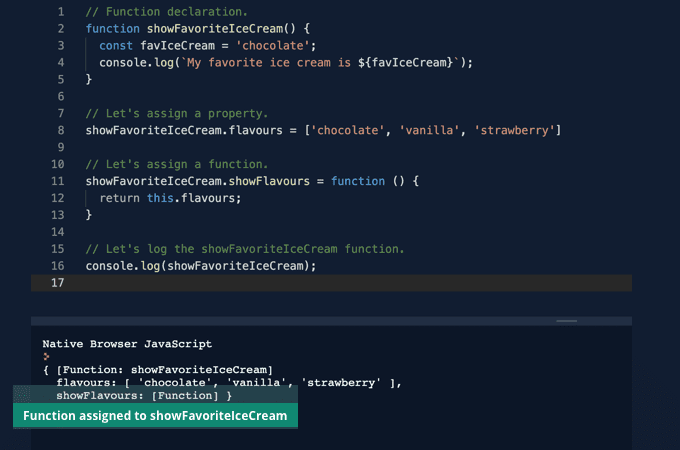
Just like before, the function object contains the assigned method.

As you can see, the showFavoriteIceCream function besides performing an action, is also behaving as an object, we are able to assign properties and methods to it.

Actually, function are known as first-class objects (or first-class citizens) which means that they can do more than that:

  1. They can be stored in variables.
          
                          // stored in a variable. (Function expression)                                                        const                              showFavIceCreams =                            function                              (              )                            {};                                          // stored in an array.                                                        const                              listOfData = [              'vanilla'              ,                            5              , showFavIceCreams];                                          // stored in object.                                                        const                              thisIsAnObject = {                                                        showListOfIceCreams              :                            function                              (              )                            {},              };                      

Preview

The function is assigned to a variable and can be called via that variable.

  1. They can be passed as parameters in another function.
          
                          // Function declaration                                                        function                                          getFavoriteIceCream              (              )                            {                                                        return                                          'chocolate'              ;              }                                           // Function declaration with params                                                        function                                          logFavoriteIceCream              (              func              )                            {                                                        return                              func();              }                                           // Passing getFavoriteIceCream as a parameter in logFavoriteIceCream                                                        console              .log(logFavoriteIceCream(getFavoriteIceCream));                            // chocolate                      

Preview
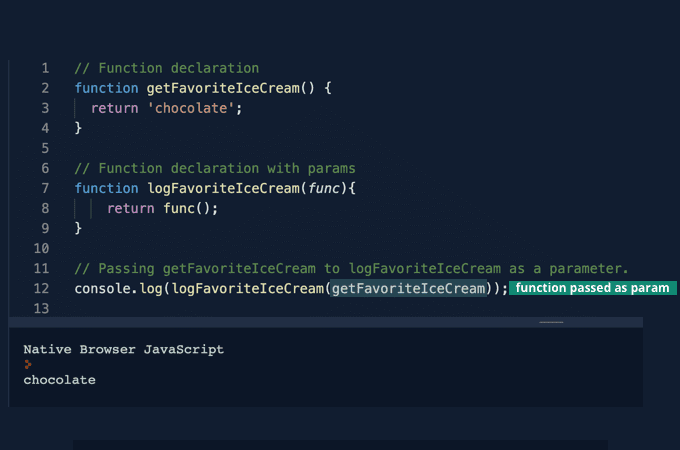
The function is passed as a parameter to another function.

  1. They can return from another function.
          
                          // Function declaration                                                        function                                          getFavoriteIceCream              (              )                            {                                                        const                              myFavIceCream =                            'chocolate'              ;                                                        // Returns another function declaration                                                                      return                                          function                              (              )                            {                                                        return                                          'My favorite ice cream is '                              + myFavIceCream;                            };               }                                           // storing function returned                                                        const                              functionReturned = getFavoriteIceCream();                                          // executing function returned                                                        console              .log(functionReturned());                            // My favorite ice cream is chocolate                      

Preview
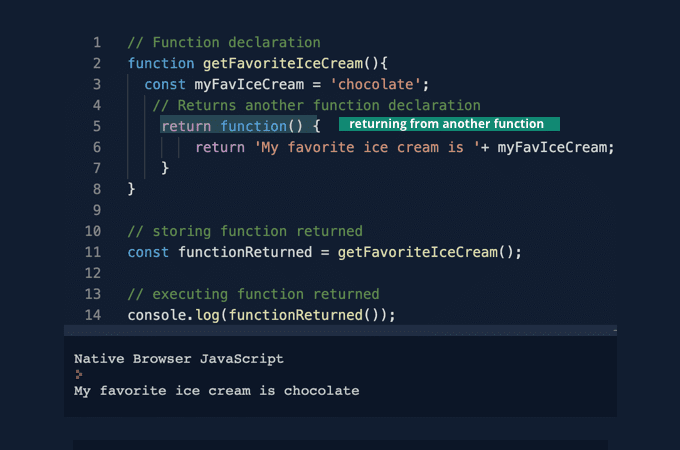
A function returns another function as a value.

Perfect, now we can say that function are objects. Now let's take a closer look at one of the logs:

If we console.log the function, it's shown as a Function type (instead of just Object)

Why are functions logged as Function (and not as "Object" or something similar)?

Well, it's because functions are not just objects, they are Function objects, meaning that besides being able to assign properties and methods to them, they also have properties and methods already defined by the built-in Function object.

Just like arrays are special kinds of objects - arrays also are regular objects with some pre-defined methods available on them. To be precise, for both the Array as well as the Function type objects, the "special" methods are defined on a special prototype.

And what is a built-in object? In JS there are standard built-in objects upon which other objects are based. Said this, the standard built-in Function is the object upon which functions are based.

The built-in Function object has properties like name, length and has methods like call, apply and bind. Let's log some of them to see an existing proof:

          
                          // Function declaration.                                                        function                                          showFavoriteIceCream              (              favIceCream              )                            {                                                        console              .log(              `My favorite ice cream is                            ${favIceCream}              `              );              }                                           // Function Properties                                                        console              .log(              'name: '                              + showFavoriteIceCream.name);                            // showFavoriteIceCream                                                        console              .log(              'length: '                              + showFavoriteIceCream.length);                            // 1                                                        // Function methods                                                        console              .log(              'call: '                              + showFavoriteIceCream.call);                            // function call()                                                        console              .log(              'apply: '                              + showFavoriteIceCream.apply);                            // function apply()                                                        console              .log(              'bind: '                              + showFavoriteIceCream.bind);                            // function bind()                      

Preview
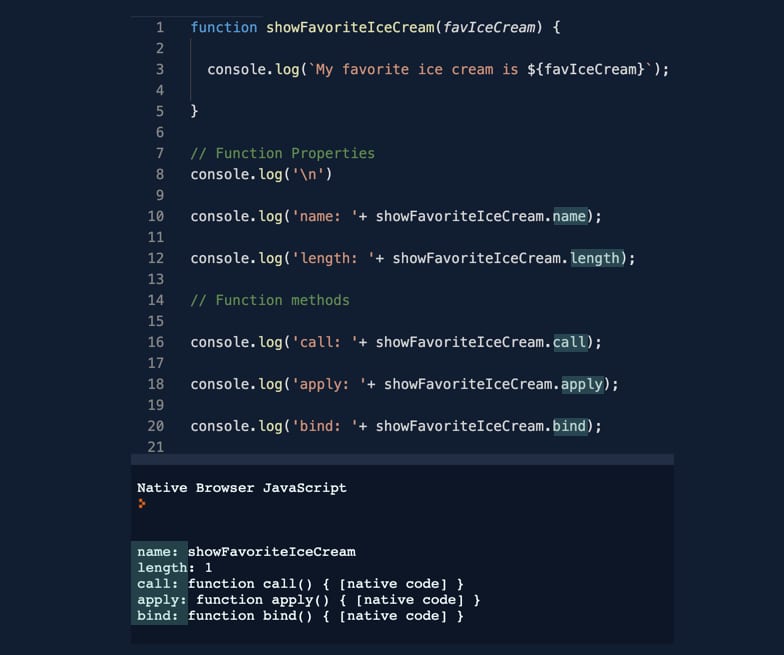
We can find all those mentioned properties and methods in the console if we log them.

name yields the name you gave the function, length shows the number of expected parameters. call(), apply() and bind() can help you with calling the function - you can learn more about these methods (mainly about bind()) in this tutorial.

Knowing this, we can see functions in a totally different perspective, and here is an example of how we can see it behind the scenes:
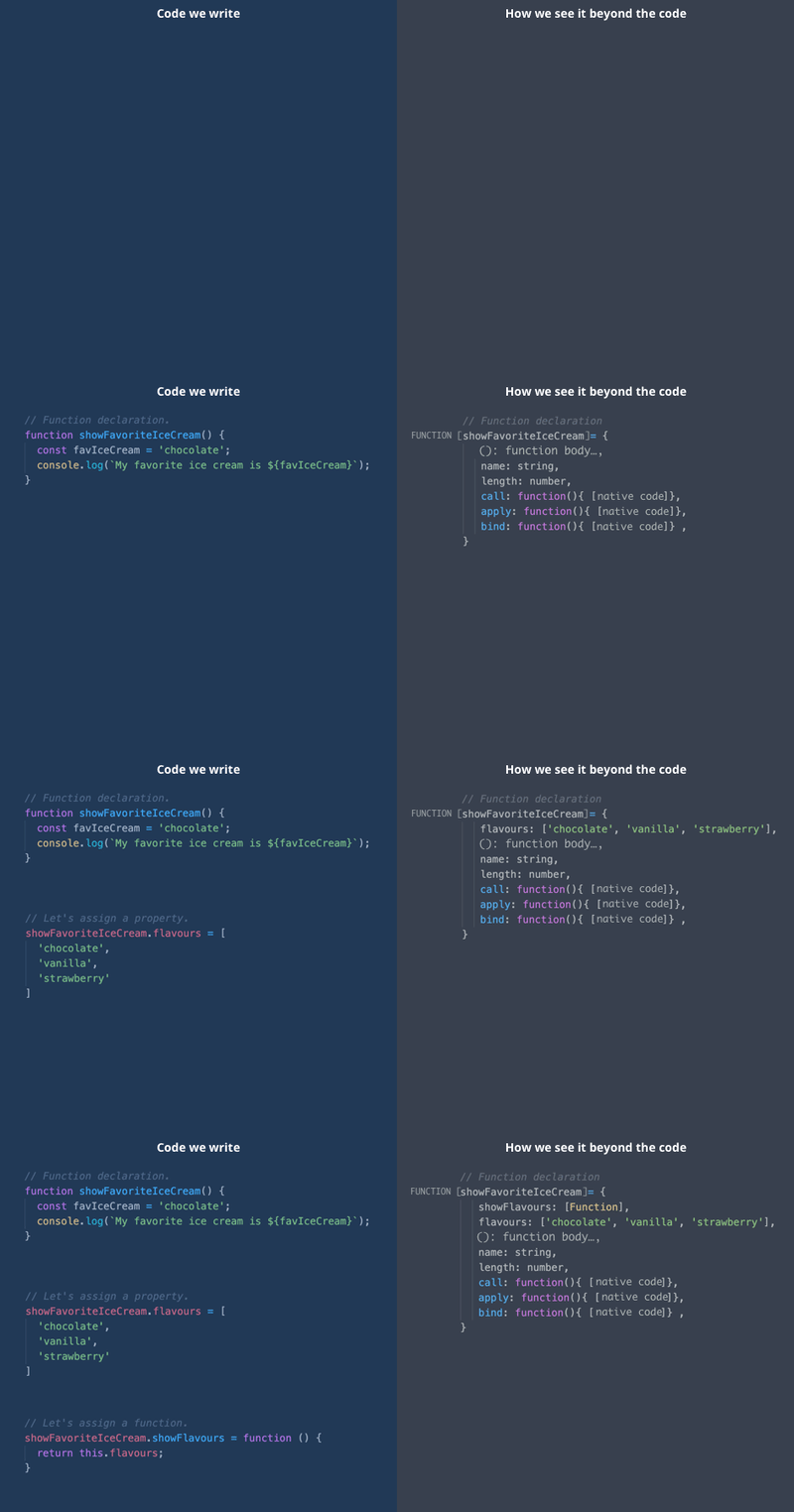
Code defining a function, side-by-side with the console.log() result of that function object being logged to the console (populated with extra methods and properties)

#Why does all that matter?

If you're new to JavaScript, it can be easy to overlook that functions are objects. And that can make it hard to understand why you can do things like myFunction.bind(). Or why functions are reference values.

Therefore it is key to understand that functions are not "some special thing" in JavaScript but that they are just objects. Objects with special, built-in methods and properties.

This article was written by Mikjail Salazar, you can visit his LinkedIn profile.

how do you create a function in javascript?

Source: https://academind.com/tutorials/javascript-functions-are-objects

Posted by: williamsblithad.blogspot.com

0 Response to "how do you create a function in javascript?"

Post a Comment

Iklan Atas Artikel

Iklan Tengah Artikel 1

Iklan Tengah Artikel 2

Iklan Bawah Artikel