

How Does Bayrons Makeup Dark Matter


4. THE NATURE OF DARK Affair
By the stop of 1970s most objections confronting the dark matter hypothesis were rejected. In particular, luminous populations of galaxies have found to accept lower mass-to-calorie-free ratios than expected previously, thus the presence of extra dark matter both in galaxies and clusters has been confirmed. However, in that location remained three bug:
- Information technology was not articulate how to explain the Big Bang nucleosynthesis constraint on the low density of matter, and the smoothness of the Hubble catamenia.
- If the massive halo (corona) is not stellar nor gaseous, of what stuff is it fabricated of?
- And a more than general question: in Nature everything has its purpose. If ninety% of thing is dark, then at that place must be a reason for its presence. What is the role of dark matter in the history of the Universe?
Offset we shall talk over baryons as dark matter candidates.
4.1. Nucleosynthesis constraints on the amount of baryonic matter
Co-ordinate to the Big Bang model, the Universe began in an extremely hot and dense state. For the get-go second it was so hot that diminutive nuclei could not form - infinite was filled with a hot soup of protons, neutrons, electrons, photons and other brusk-lived particles. Occasionally a proton and a neutron collided and sticked together to grade a nucleus of deuterium (a heavy isotope of hydrogen), but at such high temperatures they were broken immediately by high-free energy photons (Schramm & Turner 1998).
When the Universe cooled off, these high-free energy photons became rare enough that it became possible for deuterium to survive. These deuterium nuclei could keep sticking to more than protons and neutrons, forming nuclei of helium-iii, helium-four, lithium, and beryllium. This process of element-germination is chosen "nucleosynthesis". The denser proton and neutron "gas" is at this time, the more of these light elements will exist formed. As the Universe expands, all the same, the density of protons and neutrons decreases and the process slows downwardly. Neutrons are unstable (with a lifetime of about 15 minutes) unless they are bound upwards inside a nucleus. After a few minutes, therefore, the free neutrons will be gone and nucleosynthesis volition stop. There is merely a minor window of time in which nucleosynthesis tin take place, and the relationship between the expansion charge per unit of the Universe (related to the total matter density) and the density of protons and neutrons (the baryonic matter density) determines how much of each of these light elements are formed in the early Universe.
According to nucleosynthesis information baryonic matter makes upwardly 0.04 of the critical cosmological density (Fig. viii). Only a small fraction, less than x%, of the baryonic affair is condensed to visible stars, planets and other compact objects. Most of the baryonic matter is in the intergalactic thing, it is concentrated besides in hot Ten-ray coronas of galaxies and clusters.
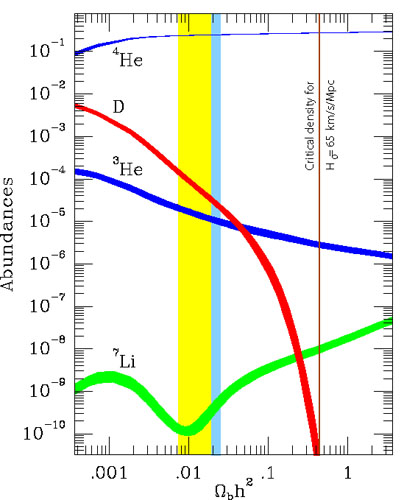 |
| Figure 8. The big-bang production of the low-cal elements. The abundance of chemic elements is given equally a function of the density of baryons, expressed in units of |
 b h 2 (horizontal axis). Predicted abundances are in agreement with measured primeval abundances in a narrow range of baryon density (
4.2. Baryonic Dark Matter
Models of the galaxy evolution are based on stellar evolution tracks, star germination rates (every bit a office of fourth dimension), and the initial mass role (Imf). For IMF the Salpeter (1955) law is usually used:
where k is the mass of the forming star, and a and n are parameters. This law cannot be used for stars of arbitrary mass, considering in this instance the total mass of forming stars may be space. Thus we assume that this law is valid in the mass interval m 0 to chiliad u (the lower and upper limit of the forming stars, respectively).
Early models of physical evolution of galaxies were constructed by Tinsley (1968) and Einasto (1972). These models show that the mass-to-light ratio M i / L i of the population i depends critically on the lower limit of the Imf, thou 0. It is natural to look that in like physical conditions (the metalicity of the gas in star formation regions) the lower mass limit of forming stars has similar values (Fig. ix). An independent check of the correctness of the lower limit is provided by homogeneous stellar populations, such as star clusters. Here we can assume that all stars were formed simultaneously, the historic period of the cluster tin can exist estimated from the Hr diagram, and the mass derived from the kinematics of stars in the cluster. Such data are bachelor for old metallic-poor globular clusters, for relatively young medium-metallic-rich open clusters as well as for metal-rich cores of galaxies. This check suggests that in the first approximation for all populations similar lower mass limits (thou 0 = 0.05 ... 0.i G  ) can be used; in contracting gas clouds above this limit the hydrogen starts burning, beneath non. Using this mass lower limits we get for quondam metal-poor halo populations M i / Fifty i
  one, and for extremely metal-rich populations in fundamental regions of galaxies M i / L i =10 ... 30, as suggested past the central velocity dispersion in luminous elliptical galaxies. For intermediate populations (bulges and disks) ane gets M i / Fifty i = iii ... x, see Fig. 9. Modern information yield slightly lower values, due to more authentic measurements of velocity dispersions in the central regions of galaxies, equally suggested in pioneering studies by Faber & Jackson (1976), Faber et al. (1977), and more accurate input data for evolution models.
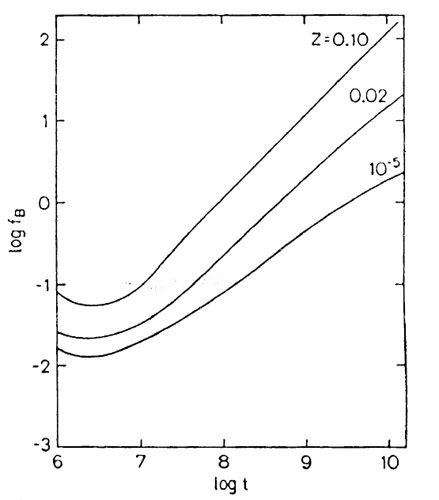 |
| Figure 9. The evolution of mass-to-light ratios f B of galactic populations of dissimilar metal abundance Z (Einasto 1972). The age of population t is expressed in years. An identical lower limit of Imf 0.1 M |
To get very high values of M / L, as suggested by the dynamics of companion galaxies or rotation data in the periphery of galaxies, one needs to apply a very pocket-sized value of the mass lower limit m 0 << x-3 M . All known stellar populations have much lover mass-to-light values, and class continuous sequences in color-Thou / 50 and velocity dispersion-1000 / 50 diagrams.
For this reason it is very hard to explain the physical and kinematical properties of a stellar dark halo. Nighttime halo stars form an extended population around galaxies, and must have a much higher velocity dispersion than the stars belonging to the ordinary halo. No fast-moving stars as possible candidates for stellar night halos were found (Jaaniste & Saar 1975). If the hypothetical population is of stellar origin, it must be formed much earlier than all known populations, because known stellar populations of different age and metalicity form a continuous sequence of kinematical and physical properties, and there is no place where to include this new population into this sequence. And, finally, information technology is known that star formation is non an efficient process - usually in a contracting gas cloud merely about one % of the mass is converted to stars. Thus we have a problem how to catechumen, in an early stage of the evolution of the Universe, a large fraction of the primordial gas into this population of dark stars. Numerical simulations propose, that in thursday early on universe only a very minor fraction of gas condenses to stars which ionize the remaining gas and end for a certain flow further star formation (Cen 2003, Gao et al. 2005b).
Stellar origin of dark matter in clusters was discussed by Napier & Guthrie (1975); they find that this is possible if the initial mass function of stars is strongly biased toward very low-mass stars. Thorstensen & Partridge (1975) discussed the suggestion made by Truran & Cameron (1971) that there may accept been a pre-galactic generation of stars (chosen now population Three), all of them more massive than the Sun, which are now nowadays as collapsed objects. They conclude that the full mass of this population is negligible, thus collapsed stars cannot make up the dark thing.
Recently weak stellar halos take been detected around several nearby spiral galaxies at very large galactocentric distances. For instance, a very weak stellar halo is establish in M31 up to distance of 165 kpc (Gilbert et al. 2006, Kalirai et al. 2006). The stars of this halo have very low metalicity, only take anomalously red color. The total luminosity and mass of these extended halos is, still, very pocket-sized, thus these halos cannot be identified with the nighttime halo.
Gaseous coronas of galaxies and clusters were discussed in 1970s by Field (1972), Silk (1974), Tarter & Silk (1974), Komberg & Novikov (1975) and others. The general conclusion from these studies was that gaseous coronas of galaxies and clusters cannot consist of neutral gas since the intergalactic hot gas would ionise the coronal gas. On the other manus, a corona consisting of hot ionised gas would exist observable. Modern information show that part of the coronal affair effectually galaxies and in groups and clusters of galaxies consists indeed of the 10-ray emitting hot gas, simply the amount of this gas is non sufficient to explain the flat rotation curves of galaxies (Turner 2003).
The result of these early discussions of the nature of dark halos were inconclusive - no appropriate candidate was found. For many astronomers this was an argument against the presence of dark halos.
4.three. Non-baryonic Dark Matter and fluctuations of the CMB radiations
Already in 1970s suggestions were made that some sort of non-baryonic uncomplicated particles, such as massive neutrinos, magnetic monopoles, axions, photinos, etc., may serve as candidates for dark matter particles. There were several reasons to search for non-baryonic particles as a night thing candidate. First of all, no baryonic thing candidate did fit the observational data. 2nd, the full corporeality of dark matter is of the order of 0.2-0.three in units of the critical cosmological density, while the nucleosynthesis constraints advise that the amount of baryonic affair cannot be higher than near 0.04 of the critical density.
A 3rd very important observation was made which caused doubts to the baryonic matter every bit the night matter candidate. In 1964 Catholic Microwave Background (CMB) radiations was detected. This discovery was a powerful confirmation of the Big Bang theory. Initially the Universe was very hot and all density and temperature fluctuations of the primordial soup were damped by very intense radiation; the gas was ionized. But every bit the Universe expanded, the gas cooled and at a sure epoch called recombination the gas became neutral. From this time on density fluctuations in the gas had a chance to grow by gravitational instability. Affair is attracted to the regions were the density is higher and it flows away from low-density regions. But gravitational clustering is a very ho-hum process. Model calculations show that in society to accept fourth dimension to build upwardly all observed structures every bit galaxies, clusters, and superclusters, the amplitude of initial density fluctuations at the epoch of recombination must be of the order of 10-3 of the density itself. These calculations as well showed that density fluctuations are of the aforementioned order every bit temperature fluctuations. Thus astronomers started to search for temperature fluctuations of the CMB radiation. None were found. Every bit the accuracy of measurement increased, lower and lower upper limits for the amplitude of CMB fluctuations were obtained. In late 1970s information technology was articulate that the upper limits are much lower than the theoretically predicted limit 10-3.
And so astronomers recalled the possible existence of non-baryonic particles, such as heavy neutrinos. This suggestion was fabricated independently by several astronomers (Cowsik & McClelland 1973, Szalay & Marx 1976, Tremaine & Gunn 1979, Doroshkevich et al. 1980b, Chernin 1981, Bail et al. 1983) and others. They found that, if dark matter consists of heavy neutrinos, then this helps to explain the paradox of small temperature fluctuations of the catholic microwave background radiation. This problem was discussed in a conference in Tallinn in April 1981. Recent experiments by a Moscow physicist Lyubimov were announced, which suggested that neutrinos have masses. If so, then the growth of perturbations in a neutrino-dominated medium tin can kickoff much earlier than in a baryonic medium, and at the time of recombination perturbations may take amplitudes large enough for structure formation. The Lyubimov results were never confirmed, but it gave cosmologists an impulse to take non-baryonic dark matter seriously. In the conference feast Zeldovich gave an enthusiastic speech: "Observers work hard in sleepless nights to collect data; theorists interpret observations, are often in error, correct their errors and try again; and there are only very rare moments of clarification. Today it is ane of such rare moments when we have a holy feeling of agreement the secrets of Nature." Non-baryonic night matter is needed to get-go structure formation early plenty. This instance illustrates well the mental attitude of theorists to new observational discoveries - the Eddington's test: "No experimental result should be believed until confirmed by theory" (cited by Mike Turner 2000). Dark matter condenses at early epoch and forms potential wells, the baryonic thing flows into these wells and forms galaxies (White & Rees 1978).
The search of dark thing can also be illustrated with the words of Sherlock Holmes "When you have eliminated the impossible, whatever remains, still improbable, must be the truth" (cited by Binney & Tremaine 1987). The not-baryonic nature of dark matter explains the office of dark thing in the development of the Universe, and the discrepancy betwixt the total cosmological density of matter and the density of baryonic matter, as institute from the nucleosynthesis constraint. Later studies have demonstrated that neutrinos are not the best candidates for the non-baryonic dark matter, see below.
4.4. Alternatives to Dark Matter
The presence of large amounts of matter of unknown origin has given rise to speculations on the validity of the Newton law of gravity at very large distances. One of such attempts is the Modified Newton Dynamics (MOND), suggested by Milgrom & Bekenstein (1987), for a discussion meet Sanders (1990). Indeed, MOND is able to represent a number of observational data without assuming the presence of some hidden matter. However, at that place exist several arguments which make this model unrealistic.
First of all, in the absence of large amounts of non-baryonic matter during the radiations domination era of the evolution of the Universe it would be impossible to get for the relative amplitude of density fluctuations a value of the order of 10-iii, needed to form all observed structures.
Second, there exist numerous straight observations of the distribution of mass, visible galaxies and the hot Ten-ray gas, which cannot be explained in the MOND framework. 1 of such examples is the "bullet" cluster 1E 0657-558 (Clowe et al. 2004, Markevitch et al. 2004, Clowe et al. 2006a), shown in Fig. 10. This is a pair of milky way clusters, where the smaller cluster (bullet) has passed the main cluster near tangentially to the line of sight. The hot 10-ray gas has been separated by ram pressure-stripping during the passage. Weak gravitation lensing yields the distribution of mass in the cluster pair. Lensing observations show that the distribution of affair is identical with the distribution of galaxies. The dominant population of the baryonic mass is in X-ray gas which is well separated from the distribution of mass. This separation is only possible if the mass is in the collisionless component, i.due east. in the non-baryonic dark matter halo, not in the baryonic X-ray gas.
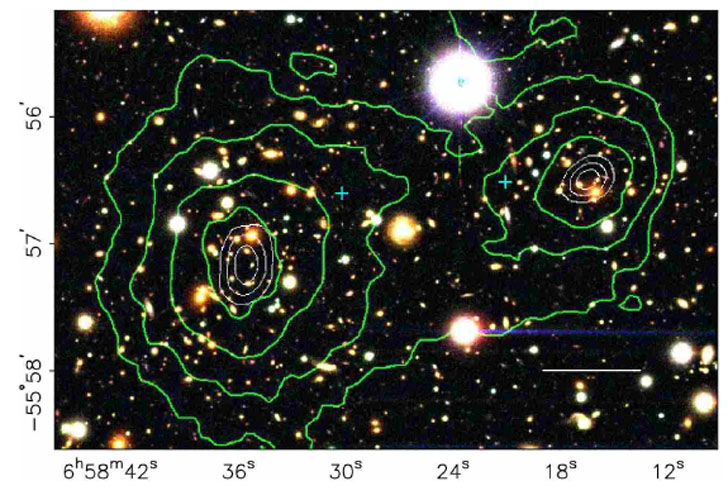 |  |
| Figure 10. Images of the merging 'bullet' cluster 1E0657-558. The left panel shows a direct image of the cluster obtained with the 6.five-chiliad Magellan telescope in the Las Campanas Observatory, the right panel is a X-ray satellite Chandra image of the cluster. Stupor waves of the gas are visible, the gas of the smaller 'bullet' cluster (right) lags backside the cluster galaxies. In both panels green contours are equidensity levels of the gravitational potential of the cluster, found using weak gravitational lensing of distant galaxies. The white bar has 200 kpc/h length at the distance of the cluster. Note that contours of the gravitational potential coincide with the location of visible galaxies, but non with the location of the Ten-ray gas (the ascendant baryonic component of clusters) (Clowe et al. 2006a) (reproduced by permission of the AAS and authors). | |

Source: https://ned.ipac.caltech.edu/level5/Sept09/Einasto/Einasto4.html
Posted by: williamsblithad.blogspot.com
0 Response to "How Does Bayrons Makeup Dark Matter"
Post a Comment